

Every tender office knows the scene. An alert arrives from the portal, someone downloads the zip file with the tender rules, technical specifications, attachments and forms, and starts reading. Two days of work later, when the technical proposal is already taking shape, a specific turnover requirement that isn’t met turns up, or a missing certification, or an evaluation criterion that rewards exactly the competitor who already runs the service in-house.
The problem isn’t losing the tender. It’s having spent days on a tender that could never be won, time taken away from one that was actually within reach.
The decision to bid (the so-called go/no-go) is the highest-leverage moment in the entire process, and also the one that gets the least method applied to it. This guide proposes a five-step path that, with the documentation at hand, can be completed in about half an hour. It doesn’t replace the in-depth analysis of whoever will write the offer: it’s there to decide whether to start it.
Why most lost tenders are lost before they even begin
In companies that regularly bid on public tenders, the bottleneck is almost never the ability to write a good offer. It’s the ability to choose which tenders deserve that capability. A tender manager’s time is finite; every offer prepared for the wrong tender is an offer not prepared for the right one.
A poorly executed go/no-go has two opposite symptoms:
- Bidding on everything, with generic, recycled technical proposals that an evaluation committee spots on the first page.
- Passing out of caution on tenders that could have been won, because no one had time to actually read the tender rules.
A fast, repeatable method solves both.
Step 1 — Participation requirements (5 minutes): the entry gate
Before any other assessment, there’s a binary question: can we even be admitted? The tender rules list general requirements, professional eligibility, economic-financial and technical-professional capacity. All of them need to be read, but in practice only a few points cause exclusion most often:
- Overall and specific turnover in the sector covered by the tender, referring to a precise number of financial years.
- Similar services or supplies performed over the past three years, with minimum amounts and sometimes a single “flagship contract”.
- Certifications (quality, environmental, safety, gender equality) required as a mandatory requirement, not just as a scoring bonus.
- Registration in professional registers or specific licenses.
- Staff requirements: professional roles with minimum qualifications and experience.
If a requirement is missing, the half hour ends here, with only two exceptions worth checking: capacity borrowing (relying on another company’s requirement) and temporary consortiums, which allow requirements to be combined with a partner. Both are legitimate and common solutions, but need to be decided immediately, since they require agreements with third parties that can’t be closed in two days.
Step 2 — The real subject of the contract (5 minutes)
The tender’s title says little. The technical specifications say everything. The question here is: is what they’re asking for really what we do, or does it just resemble it?
Pay particular attention to:
- Ancillary activities that don’t appear in the title but weigh heavily during execution (training, maintenance, on-site presence, on-call availability).
- Places of execution: a service spread across twenty sites in three regions is a different contract from one concentrated in a single site.
- Duration and options: extensions, renewals, the “one-fifth” contractual option. These change the contract’s real value and organizational commitment.
- Social clauses and obligations to re-hire the outgoing staff.
A recurring mistake is evaluating a tender based on the base auction amount without understanding how much of that amount will go into activities the company doesn’t handle in-house and would need to subcontract.
Step 3 — Evaluation criteria (10 minutes): where you actually win
This is the step deserving the most time, because it’s the one that distinguishes an open tender from an already-written one.
In the most economically advantageous tender, the criteria grid tells you exactly what the contracting authority rewards, and how much. It should be read with three questions in mind:
- What’s the ratio between technical and economic score? With 70 points on technical merit and 30 on price, you win on offer quality; with 50/50 or worse, price weighs more and margins get thinner.
- Are the rewarded criteria within our reach? If many points go to prior experience in a very specific context, to certifications we don’t have, or to technological solutions we don’t offer, the realistic maximum score drops quickly.
- Are there “tabular” or on/off criteria that are won or lost as a block? These are the easiest to estimate and often make the difference.
The useful exercise is blunt but quick: go through each criterion and assign yourself a realistic score, not the hoped-for one. If the sum is far from the maximum, and price carries little weight, the tender belongs to someone else.
A signal worth noticing: extremely detailed criteria about a specific solution are often a reflection of a dialogue that already took place between the contracting authority and one operator. It’s not unlawful, but it is information.
Step 4 — Economic value and sustainability (5 minutes)
The question here is: even if we won, would it be worth it?
- Base auction amount versus our costs: if the price is already tight before any discount, every point of discount comes out of margin.
- Historical discount rates on similar tenders from the same contracting authority, if available.
- Payment terms, advance payments, penalties, guarantees: these affect cash flow more than they seem to.
- Costs of participation itself: mandatory site visits, provisional bond, ANAC contribution fee, possible sample submissions.
A tender won at a loss is a problem that lasts three years. Better to find out at minute twenty-five.
Step 5 — The calendar (5 minutes)
Last check, often overlooked: can we, in the time available, put together a competitive offer?
Check the deadline, the cutoff date for clarification requests (almost always well before the deadline), any mandatory site visit windows, and the time needed to involve any partners or subcontractors. An excellent tender with ten days left and a consortium still to build might simply not be feasible.
The go/no-go sheet: a reusable model
The result of the five steps fits on one page. That page is the go/no-go sheet, and it’s the only output of the half hour:
| Area | Outcome | Notes |
|---|---|---|
| Participation requirements | Yes / No / With capacity borrowing or consortium | Which requirement is critical |
| Subject of the contract | Core / Adjacent / Out of scope | Activities to subcontract |
| Evaluation criteria | Realistic technical score / max | Criteria lost as a block |
| Economic sustainability | Expected margin at likely discount | Penalizing conditions |
| Calendar | Feasible / Tight / Not feasible | Intermediate deadlines |
| Decision | GO / NO-GO | Who decides, when |
Filled out the same way every time, the sheet does two things: it makes the decision comparable across different tenders, and it creates a track record. After a year, it becomes clear which types of tenders you win and which you lose — information worth more than any consultancy.
Where the half hour actually goes
The costly part of this method isn’t the reasoning: it’s finding the information inside tender documentation that arrives as dozens of files, with requirements scattered across the rules, specifications and attachments, and evaluation criteria in tables that reference other paragraphs.
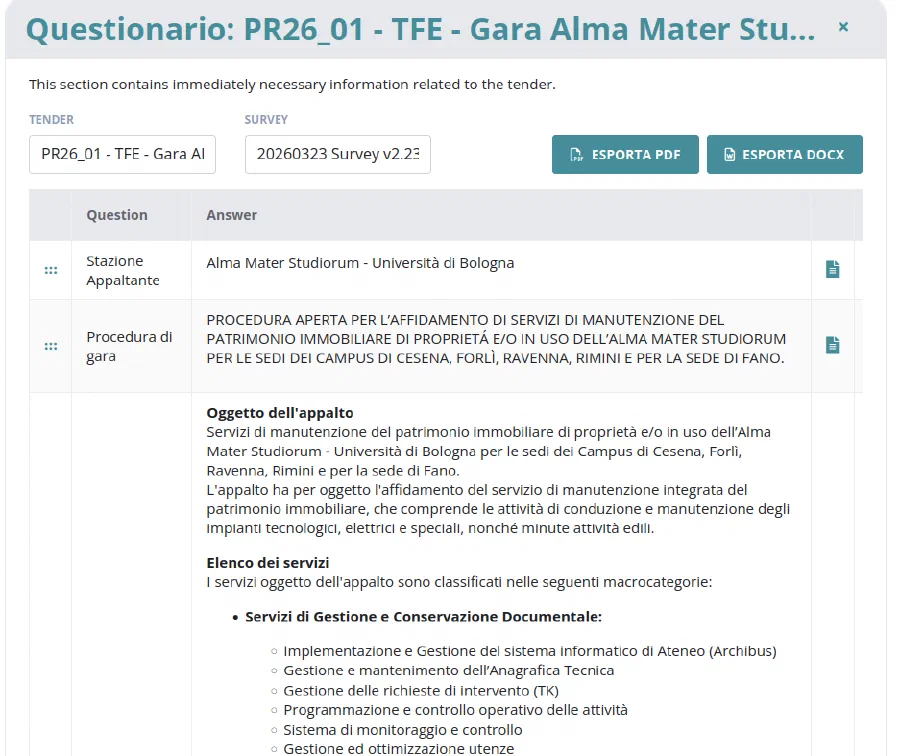
This is exactly the work Tender Brain was built for. You upload the zip file exactly as downloaded from the contracting authority’s portal, and the tool automatically generates a summary sheet with participation requirements, subject matter, evaluation criteria with their scores, amounts, and deadlines. The five steps in this guide are already extracted; what’s left is the assessment, which is up to whoever knows the company. Any doubt can be resolved by querying the documentation directly in natural language, without reopening the PDFs.
Your documents stay within your company’s perimeter: Tender Brain never accesses your data.
Book a free demo and try the method on a tender you’re evaluating right now.